
Table of Contents
- How Stress and Relaxation Differ in the Body
- Relaxation vs Stress Reduction: Two Different Jobs
- The Balanced Design Framework for Coloring
- Coloring Book Difficulty Levels and the Calming Response
- Benefits of Adult Coloring for Anxiety
- Best Coloring Books for Relaxation by Time Available
- Common Mistakes That Turn Coloring Into Another Stressor
- Frequently Asked Questions
Last Updated: September 21, 2026
How Stress and Relaxation Differ in the Body
Relaxation and stress reduction are not the same thing, and treating them as interchangeable explains why so many people finish a coloring session still wound up. Relaxation is a short-term state: muscles loosen, breathing slows, and the mind quiets for a while. Stress reduction is a longer project: it lowers the baseline load your body carries all day. One is a pause. The other changes the number the pause starts from.
The distinction matters because the two states run on different parts of the nervous system. The autonomic nervous system manages the split between alert and calm. Stress activates the sympathetic branch, the one that raises heart rate and tightens muscles.
Relaxation vs Stress Reduction: Two Different Jobs
The relaxation vs stress reduction question comes down to timing and mechanism. Relaxation is a state you enter and leave. Stress reduction is a change in how easily you enter that state at all. Confusing the two leads people to pick activities that feel nice but never move their baseline.
What Relaxation Actually Does
Relaxation is the deliberate activation of the parasympathetic nervous system, producing a calming response within minutes. It lowers muscular-skeletal tension, slows breathing, and quiets mental chatter. The effect is real but temporary: stop the activity and the state fades. Think of it as a recovery window, not a repair.
What Stress Reduction Actually Does
Stress reduction is the cumulative lowering of chronic stress load over weeks, built from repeated relaxation, movement, sleep, and cognitive reframing. It changes how quickly you return to baseline after a stressor, a quality often called resilience. Relaxation is one input into that process, not the whole process.
Relaxation is the session. Stress reduction is the trend line. You need both, but they are measured on different clocks.
The Balanced Design Framework for Coloring
The Balanced Design framework is a way to choose a coloring page by matching its difficulty to the job you need done that day. It rests on one idea: a page that is too easy bores you, and a page that is too hard frustrates you. Both outcomes defeat the purpose, because both push you back toward the sympathetic branch of the autonomic nervous system instead of the parasympathetic one.
- Complexity (1-3): how many small, detailed regions the design contains. A large open mandala scores 1. A medium botanical motif scores 2. An intricate cityscape with hundreds of tiny windows scores 3.
- Time (1-3): how long a realistic session will run. Under 10 minutes scores 1. Ten to 30 minutes scores 2. Over 30 minutes scores 3.
- Energy (1-3): whether you arrive tired (1), restless (2), or steady (3).
A Worked Example
It is 9:15 p.m. You finished work late, your shoulders are tight, and you have about 20 minutes before bed. Complexity: you want something that does not demand fine motor precision, so 1. Time: 20 minutes, so 2. Energy: tired but wired, so 2. Total: 5. That points to a large open pattern with three or four colors, not the intricate botanical page you bought last month.
Why the Framework Maps to Relaxation vs Stress Reduction
The framework does double duty. A matched session delivers relaxation, the short-term parasympathetic state. A matched session repeated most evenings is what builds stress reduction, the cumulative lowering of chronic load. Mismatched sessions deliver neither, because frustration activates the sympathetic branch and undoes the calm you were chasing.
Score complexity, time, and energy from 1 to 3, add them, and pick a page that matches the total. A matched page relaxes you tonight. A matched routine lowers your baseline over weeks.
Coloring Book Difficulty Levels and the Calming Response
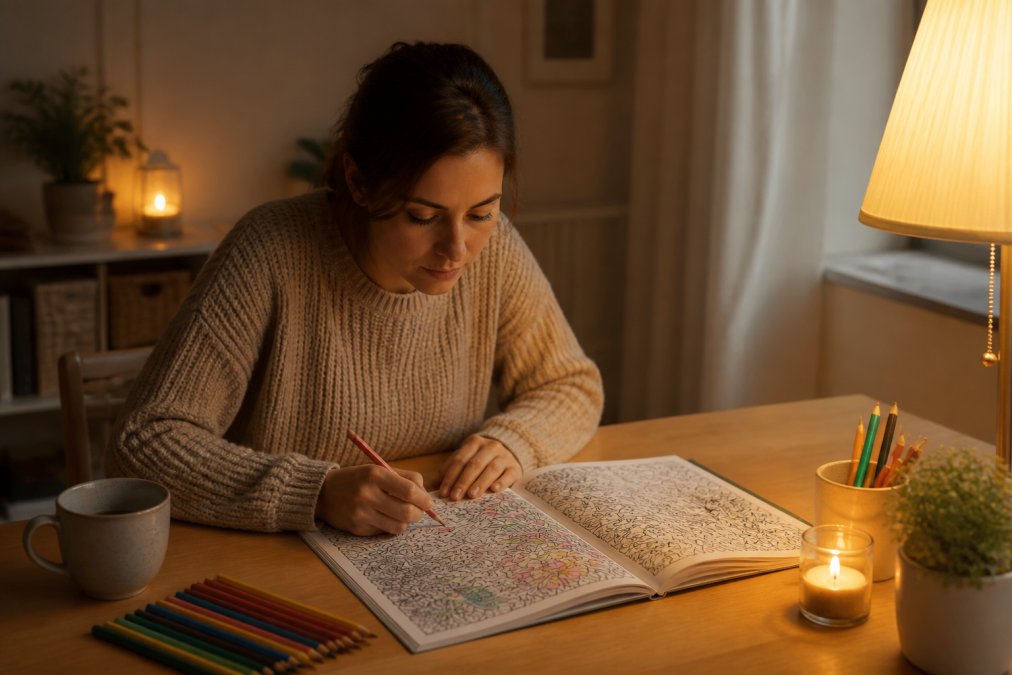
Coloring book difficulty levels describe how much sustained attention a page demands, and that demand drives the calming response. A simple mandala with large open areas lets your hands move while your mind drifts, which suits a tired evening. An intricate botanical scene with dozens of small leaves pulls your attention inward and crowds out rumination, which suits a restless mind that will not sit still.
- Region count: how many discrete shapes you must fill. More regions means more decisions per minute.
- Region size: small regions demand fine-tip tools and steady hands. Large regions tolerate markers and broad strokes.
- Color decisions: a page that suggests a palette is easier than a blank one where you must invent every color relationship.
- Symmetry and pattern: repeating patterns let the eye predict the next region, which lowers cognitive load even when the page looks busy.
Matching Complexity to Your Energy
The rule is simple: match the page to the energy you actually have, not the energy you wish you had. High energy and a restless mind pair well with dense, detailed designs. Low energy after a long day pairs better with simpler patterns and a small palette.
- Wired and can’t settle: intricate designs, many small regions, fine-tip pencils. The fine motor demand absorbs the restless energy.
- Tired but tense: medium complexity, broad shapes, a handful of colors. Enough structure to hold attention, not enough to demand precision.
- Drained and foggy: large open patterns, minimal decisions, soft markers. The goal is a low-friction entry, not a challenge.
The Failure Modes on Each End
Too easy and the mind wanders back to the worry it was trying to escape, you finish the page more agitated than you started. Too hard and you trigger the frustration response: jaw tightens, breathing shallows, and the sympathetic branch takes over. The sweet spot is the page that is just demanding enough to hold attention without demanding so much that it becomes a performance.
Keep two books on hand: a simple one for low-energy nights and a detailed one for restless ones. Choosing the wrong difficulty is the most common reason people quit coloring.
Benefits of Adult Coloring for Anxiety
The benefits of adult coloring for anxiety come from two mechanisms working together. First, repetitive fine motor work occupies the parts of the brain that would otherwise loop on worries, which is why many people describe the activity as a form of mindfulness meditation with a pencil in hand. Second, the physical act encourages slower, deeper breathing without anyone having to instruct you to breathe.
Best Coloring Books for Relaxation by Time Available
The best coloring books for relaxation are the ones that fit the time you actually have, not the time you plan to have. A page you can finish in one sitting feels rewarding. A page that takes four evenings can start to feel like a chore. Pick by the clock.
Five Minutes, Fifteen Minutes, One Hour
| Time Available | Design Type | Best For | Watch Out For |
|---|---|---|---|
| 5 minutes | Large open patterns, bold shapes | Lunch breaks, waiting rooms | Feeling unfinished |
| 15 minutes | Medium detail, single motif | After-work wind-down | Rushing the shading |
| 1 hour | Intricate scenes, many regions | Deep focus sessions | Hand fatigue, eye strain |
Beautiful Coloring Books offers a diverse collection with over 320 unique inspirations, ranging from intricate nature and fantasy themes to abstract art, ensuring there is a perfect match for every imagination. This allows you to pick a book that suits the evening you are having rather than the mood you hoped for. For readers who want the science behind why repetitive creative work calms the mind, the National Institute of Mental Health on stress and the brain is a solid starting point.
Common Mistakes That Turn Coloring Into Another Stressor
The biggest mistake is treating coloring as a performance. The moment you start judging your shading or comparing your page to someone else’s, you have handed the task back to your stress response.
Other traps that quietly undo the benefit:
- Choosing designs above your skill level, which triggers frustration instead of a calming response
- Chasing completion rather than enjoying the process, turning a hobby into a deadline
- Coloring in a chaotic space with notifications on, which blocks the shift into somatic awareness
- Skipping it on hard days, exactly when a short, low-stakes session would help most
Frequently Asked Questions
What is the difference between relaxation and stress reduction?
Relaxation is a short-term state: your breathing slows, muscles loosen, and the parasympathetic nervous system takes over for a while. Stress reduction is the cumulative effect of repeated relaxation, plus sleep, movement, and other habits, on cortisol levels and blood pressure over weeks. Coloring can deliver both, but only if the design difficulty matches your energy on a given day. Too easy and you get bored; too hard and you get tense.
Can a coloring book be too difficult and cause more stress?
Yes. When a design has tiny spaces, overlapping lines, or more detail than you can comfortably track, your attention shifts from the page to the fear of ruining it. That triggers the same acute stress response you were trying to escape. The fix is to size the challenge to your skill level: choose simpler, larger shapes on tired days and save the intricate pages for when you feel sharp.
How do I choose the right coloring book difficulty for my skill level?
Start with the time you actually have. Five spare minutes suits bold, large-print designs with wide spaces. Fifteen minutes suits medium-detail florals or mandalas. An hour or more suits highly intricate patterns. If you finish a page and feel calm rather than drained, the difficulty was right. If you felt rushed or frustrated, step down one level.
How does design complexity affect the relaxation response?
Complexity controls how much of your attention the page absorbs. Moderate complexity, where the pattern is engaging but not overwhelming, produces the strongest calming response because it interrupts rumination without demanding problem-solving. Research on coloring and anxiety suggests the repetitive, predictable motion of filling shapes helps regulate emotion. Pages that are too simple let your mind wander back to work; pages that are too complex keep you in a state of effort.
Stress builds quietly, and the fix is rarely one heroic session. It is a small, repeatable habit that fits the evening you are actually having. Beautiful Coloring Books curates over 320 designs across every difficulty level, from five-minute patterns to hour-long intricate scenes, all available through convenient Amazon KDP delivery so you can start tonight. Browse the collection and pick a page that matches your energy, not your ambition.
