
Table of Contents
- Why Adult Colouring Prints Are More Than a Hobby
- The Best Coloring Books for Stress Relief (and How to Spot Them)
- Printable Coloring Pages for Beginners: A Low-Pressure Start
- How to Choose Coloring Pencils for Adults
- Paper Quality and Printer Settings: What Most Guides Skip
- Simple vs Intricate Designs: Matching Complexity to Your Mood
- Digital Coloring Compatibility: Using Prints on Tablets
- Conclusion
- Frequently Asked Questions
Last Updated: September 19, 2026
Why Adult Colouring Prints Are More Than a Hobby
Adult colouring prints are downloadable, high-resolution line art pages designed specifically for grown-ups, and their appeal goes well beyond filling an afternoon. This guide from Beautiful Coloring Books explains why they work, how to choose them, and how to get the best results from your printer and pencils.
The Best Coloring Books for Stress Relief (and How to Spot Them)
The best coloring books for stress relief share three traits: clear line art, quality paper, and a theme that holds your attention without frustrating you. Miss any one of these and the session turns into a chore.
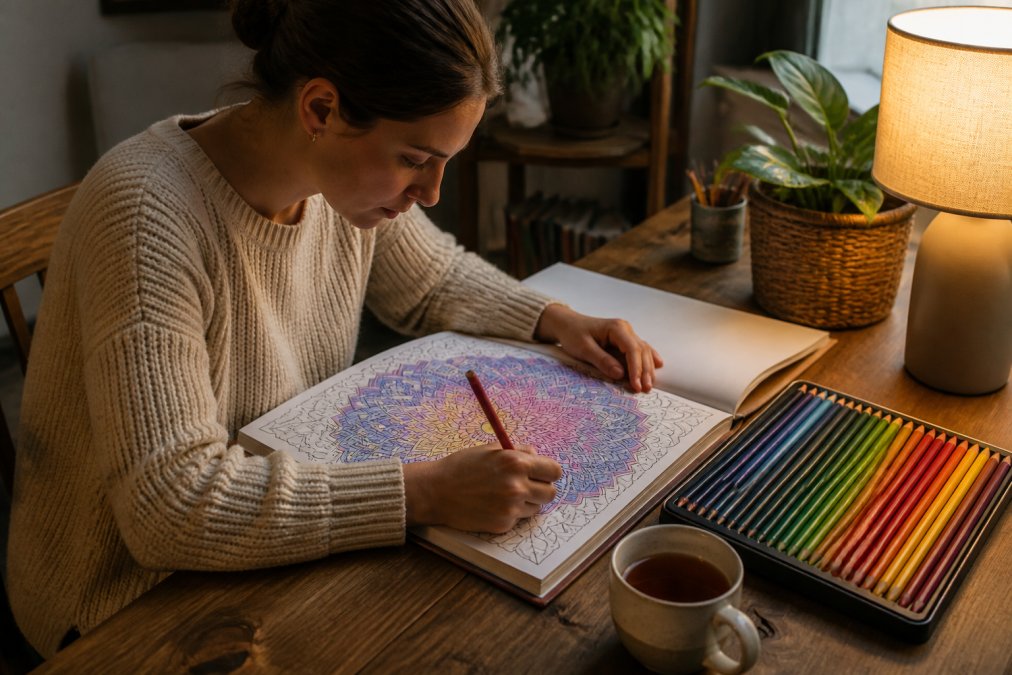
What Makes a Coloring Book Actually Relaxing
Relaxation comes from flow, not from difficulty. A page that is too complex creates decision fatigue; a page that is too simple creates boredom. The sweet spot is line art detailed enough to absorb you for 30 to 60 minutes, with sections small enough to finish in one sitting so you feel a sense of completion.
Themes That Support Mindfulness and Focus
- Nature and botanicals: leaves, flowers, and woodland scenes invite slow, meditative shading
- Geometric patterns and mandalas: symmetry gives the eye a rhythm to follow, which many people find deeply grounding
- Fantasy and whimsical scenes: best for colorists who want a story to unfold as they work
- Abstract designs: the most forgiving option for beginners, since there is no “wrong” color choice
The right theme is the one you look forward to opening. That sounds obvious, but it is the single biggest predictor of whether you stick with the habit.
Printable Coloring Pages for Beginners: A Low-Pressure Start
Printable coloring pages for beginners remove the two biggest barriers to starting: cost and commitment. You download a PDF, print a single page, and try it. No trip to the store, no shelf space, no guilt if the design is not for you.
How to Download and Print at Home
- Choose a design and download the PDF to your device.
- Open the file and confirm the page is sized for standard letter paper (8.5 x 11 inches). Most adult coloring PDFs are built to this size, but a few are A4, which is slightly narrower and taller.
- In your print dialog, select “Actual size” rather than “Fit to page.” Scaling shrinks the line art and can close up fine detail.
- Set print quality to “Best” or “High.” Draft mode saves ink but produces faint, broken lines that are hard to follow.
- Choose the correct paper type in the driver menu (plain, matte, or photo) so the printer adjusts how much ink it lays down.
- Print one test page before committing to a full set.
That last step saves more paper than any other habit. Print a single page, color a small section, and check how your chosen medium behaves on that paper before committing to a batch.
Paper Weight, DPI, and the Settings That Actually Matter
Most guides tell you to “print on good paper” and stop there. Here is what the numbers mean so you can pick correctly the first time.
- Paper weight (basis weight): Standard copy paper is 20 lb. It handles colored pencils fine but ghosts and bleeds with markers. Step up to 24 lb for light marker work, 32 lb for alcohol markers, and 65-80 lb cardstock for watercolor or framing.
- Resolution (DPI): A quality adult coloring PDF is exported at 300 DPI so the line art stays crisp when printed at full size. If a file is only 72 DPI, lines will look fuzzy no matter what printer you use. Check the file properties before you print a batch.
- Ink vs. toner: Laser printers (toner) produce sharper black lines and resist smearing under markers. Inkjet printers handle color and matte paper better but can bleed if the page gets wet.
- Print mode: “Photo” or “Fine art” mode lays down more ink and slows the print head, which sharpens fine lines. Use it for intricate mandalas; skip it for bold large-print designs where it just wastes ink.
- Matte vs. glossy: Matte paper takes pencil layering and blending better. Glossy paper suits markers and looks vivid but resists pencil and can smudge.
Print a test page and color one small corner with each medium you own before starting a full design. Five minutes of testing tells you more about paper and pencil compatibility than any product description.
Using alcohol-based markers on standard 20 lb printer paper will bleed straight through and can ruin the page underneath. If markers are your medium, print on 32 lb stock or heavier, or place a spare sheet beneath your work.
A Simple Beginner Setup
If you are starting from zero, this combination covers almost every design without waste:
- A ream of 32 lb matte paper for markers and fineliners
- A small pack of 65 lb cardstock for watercolor or pages you plan to frame
- A mid-range soft-core colored pencil set plus a colorless blender pencil
- A laser printer if you have access to one, or an inkjet set to “Best” quality on matte paper
How to Choose Coloring Pencils for Adults
Choosing coloring pencils for adults comes down to three variables: pigment softness, core hardness, and how you plan to blend. There is no single best pencil, only the best match for your technique. This section covers both the supplies and the beginner techniques most guides skip.
Pencils, Markers, or Fineliners: What Works Best
| Medium | Best For | Watch Out For |
|---|---|---|
| Colored pencils | Blending, shading, fine detail | Slow coverage on large areas |
| Markers | Bold, even color blocks | Bleed-through on thin paper |
| Fineliners | Outlines, tiny intricate sections | Limited shading range |
| Watercolors | Soft washes, gradient effects | Requires heavier paper |
Soft-core pencils lay down rich color quickly and blend beautifully, but they need sharpening often. Hard-core pencils hold a point longer and suit fine, intricate line art, though building deep color takes patience. If you are new to shading, start with a mid-range soft-core set and add a colorless blender pencil, which smooths transitions without introducing new pigment.
Beginner Techniques: Shading, Blending, and Layering
Most adult coloring prints are line art, which means the color and depth are entirely up to you. Three techniques do most of the work:
- Pressure shading: Color with light pressure, then build up layers in the areas you want darker. This is the simplest way to create a gradient inside a single shape without switching pencils.
- Layering: Apply a light base color, then go over it with a second color. Yellow under green, or blue under purple, produces richer, more natural tones than either pencil alone. Two or three thin layers beat one heavy layer every time.
- Blending: Use a colorless blender pencil, a white pencil, or a paper stump to smooth the transition between two colors. Work in small circles rather than back and forth strokes to avoid streaks.
A Quick Word on Color Theory
You do not need an art degree to make a page look cohesive. Two rules cover most situations:
- Analogous palettes: Pick colors next to each other on the color wheel (blue, blue-green, green). The result is calm and harmonious, which suits nature and botanical designs.
- Complementary accents: Pick one color and its opposite (blue and orange, purple and yellow) and use the second sparingly as an accent. This creates contrast and makes focal points pop in geometric and mandala designs.
Using alcohol-based markers on standard printer paper will bleed straight through and can ruin the page underneath. If markers are your medium, print on heavier stock or place a spare sheet beneath your work.
Buy mid-range pencils, not the cheapest set and not the most expensive. Technique matters more than pigment at the beginner stage, and a colorless blender pencil will improve your results more than upgrading your entire set.
Paper Quality and Printer Settings: What Most Guides Skip
Paper weight is the most overlooked variable in home printing, and it decides which mediums you can use. Standard copy paper sits around 20 lb and handles pencils fine. Step up to 32 lb or cardstock and markers become viable without bleed-through.
- Pencils only: 20-24 lb paper is sufficient
- Markers or fineliners: 32 lb or heavier
- Watercolors: heavyweight watercolor paper, printed with a laser printer if possible
- Gifting a finished page: print on cardstock so it holds up to framing
Simple vs Intricate Designs: Matching Complexity to Your Mood
Complexity should match your energy, not your skill level. On a draining day, a bold large-print design with wide open sections lets you color almost automatically. On a focused evening, an intricate pattern with fine details keeps your attention locked in.
Match the design to your energy, not your ability. Simple prints are not “beginner” pages; they are low-energy-day pages, and every colorist needs them.
Digital Coloring Compatibility: Using Prints on Tablets
Most downloadable PDFs work on tablets, which opens up a screen-based option for people who travel or want to try a color palette before committing to paper. Import the PDF into a note-taking or drawing app, add a layer beneath the line art, and color digitally with a stylus. The line art stays intact while your color sits on its own layer, so mistakes erase cleanly.
Conclusion
The hardest part of building a coloring habit is not talent or supplies. It is finding designs that match the mood you are actually in, on paper that cooperates with the medium you actually use. Get those two things right and the practice sustains itself.
Frequently Asked Questions
Where can I find printable adult coloring pages?
Printable adult coloring pages are available through online marketplaces, artist websites, and digital download platforms. Look for high-resolution PDF files that are letter-sized and designed for standard home printers. Many sellers offer instant access after purchase, so you can start coloring the same day. Check that the line art is crisp and the file is vector-based or high-resolution for clean printing.
What are the best coloring pages for adults to reduce stress?
Designs with repetitive geometric patterns, mandalas, and nature-inspired illustrations tend to work well for stress relief because they encourage a meditative rhythm. Intricate designs can absorb your attention and quiet racing thoughts, while simpler line art offers a gentler entry point. The best choice depends on your mood and energy level. Many people keep a mix of complex and simple prints on hand.
How do I choose the right complexity for adult coloring prints?
Start by matching the design to your available time and focus. If you have 15 minutes after work, a simple geometric pattern or large-print illustration may feel more achievable than a dense mandala. If you want a longer, absorbing session, intricate designs with fine details work well. Beginners often benefit from starting with medium complexity and gradually moving to more detailed pieces as confidence grows.
Are there different types of paper recommended for adult coloring prints?
Yes. For markers, a heavier paper (around 80 lb / 216 gsm or higher) helps prevent bleed-through. Colored pencils work well on standard 65 lb / 176 gsm paper with a slight tooth. If you print at home, choose a matte or uncoated paper setting and test a small area first. For watercolors, you need dedicated watercolor paper, as standard printer paper will warp and pill.
