
Table of Contents
- Quick Comparison: Top Paper Types for Alcohol Markers
- Why Paper Choice Makes or Breaks Your Alcohol Marker Art
- Alcohol Marker Bleed-Proof Paper: What It Is and How to Spot It
- How to Prevent Alcohol Marker Bleed Through: Practical Fixes
- Marker Paper vs Mixed Media Paper: Which One Belongs in Your Kit?
- Paper Weight, Texture, and Blending: The Specs That Actually Matter
- Budget-Friendly DIY Testing Methods for Alcohol Markers Paper
- Frequently Asked Questions
Last Updated: September 21, 2026
Quick Comparison: Top Paper Types for Alcohol Markers
Finding the best paper for alcohol markers comes down to three things: a smooth, coated surface, enough weight to stop bleed-through, and low absorbency so your colors stay bright. This review guide breaks down how each paper type performs so you can choose with confidence.
Alcohol markers behave nothing like water-based ones. Their solvent-based ink soaks straight into paper fibers, and a sheet that feels thick to the touch can still let color bleed through to the next page. The table below summarizes how the main options compare.
| Paper Type | Surface | Bleed Control | Best For |
|---|---|---|---|
| Bleedproof marker paper | Smooth, coated | Excellent | Blending, layering |
| Bristol board | Smooth or vellum | Very good | Detailed illustration |
| Mixed media paper | Textured | Moderate | Mixed techniques |
| Heavyweight cardstock | Varies | Good | Finished pieces, gifts |
A quick note on price: paper costs shift with brand, sheet count, and size. Check current retail listings for exact figures before you buy.
Why Paper Choice Makes or Breaks Your Alcohol Marker Art
The wrong paper ruins good markers. That sounds dramatic, but it’s true, and most beginners learn it the expensive way.
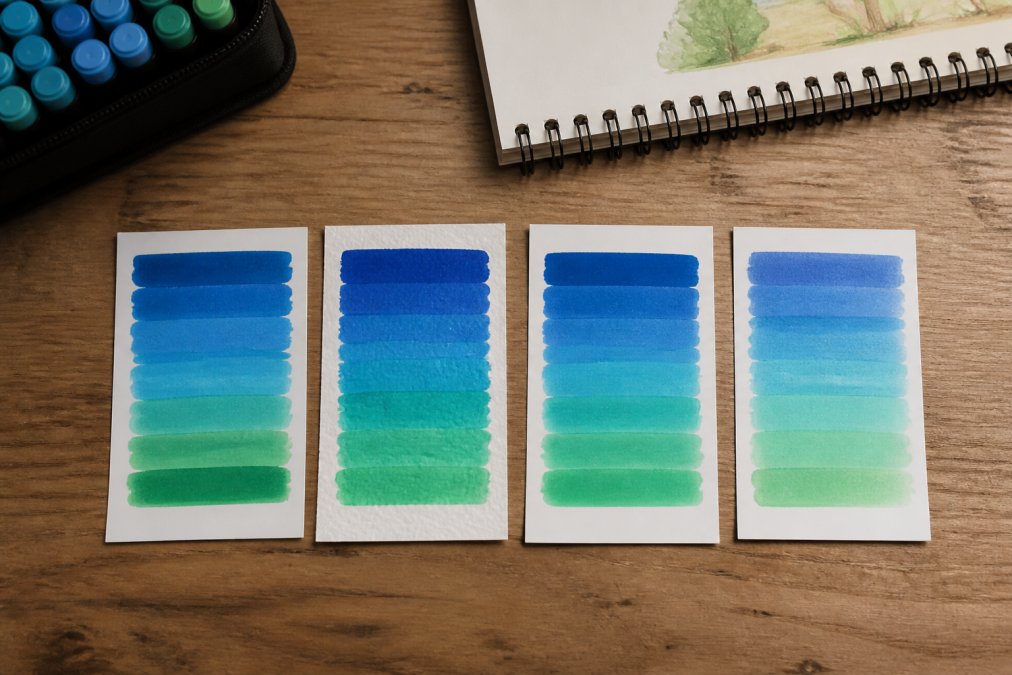
Alcohol markers push a lot of ink onto a page fast. A thin, absorbent sheet drinks that ink up, which dulls the color, spreads the edges, and sends the ink straight through to whatever is underneath. A coated, heavier sheet keeps the ink closer to the surface, so colors stay vivid and blends stay smooth.
Paper weight is measured in grams per square meter (gsm). For alcohol markers, many artists find that 100 gsm is the absolute floor and 150 gsm or higher gives noticeably better results. Fiber density matters just as much as thickness, though, which is why a dense 120 gsm marker pad can outperform a fluffy 160 gsm sketchbook page.
What most guides miss is that a paper’s coating, not its weight, does most of the work. A coated surface resists absorbency, and resistance is what keeps your marker performance consistent from the first stroke to the last.
Alcohol Marker Bleed-Proof Paper: What It Is and How to Spot It
Alcohol marker bleed-proof paper is a coated sheet engineered to stop solvent-based ink from passing through to the reverse side. The coating is the whole trick: it seals the top of the fiber web so solvent can’t wick downward, which protects the page beneath and keeps colors from turning muddy.
Most bleedproof pads use a thin clay or polymer coating applied to one or both sides. That’s why a 70 gsm bleedproof marker pad can outperform a 200 gsm uncoated sketchbook page, the coating, not the thickness, is doing the work.
Real product categories to know. You’ll see bleedproof paper sold under a few recognizable formats:
- Dedicated marker pads, thin, coated, often 70-90 gsm, sold in glue-bound or tape-bound blocks. These are the classic choice for illustration and rendering.
- Bleedproof layout paper, very thin translucent sheets used for roughs and overlays; great for tracing and layering reference, less ideal for finished pieces.
- Coated Bristol board, heavier (usually 200 gsm and up), smooth, and rigid; the go-to when you want a finished piece that won’t buckle.
- Coated cardstock, variable quality; some coated cardstocks behave like marker paper, others feather badly. Test before committing.
How to spot true bleedproof paper in the store:
- Look for the word “bleedproof” on the cover. Marker pads usually state it outright.
- Check the coating. Run a fingernail across the sheet. A slight slickness means a coating; a rough drag means bare fiber.
- Read the weight. Under 100 gsm rarely qualifies unless the sheet is coated, and if it’s coated, thin is fine.
- Test with a dark marker. One firm stroke of black tells you more than any product description.
A related term to know is feathering, when ink wicks along paper fibers and creates fuzzy, hairy edges.
Bring one of your darkest markers to the store and ask to test a corner of the pad. Most art supply shops keep open samples for exactly this. A single black stroke reveals more about a paper than the entire label.
A quick compatibility note. Not every bleedproof sheet plays nicely with every marker. Alcohol markers from different manufacturers vary in solvent load and pigment concentration, so a pad that performs beautifully with one brand can still ghost slightly with another. If you switch marker brands, re-run the black stroke test on your current paper before starting a finished piece.
How to Prevent Alcohol Marker Bleed Through: Practical Fixes
You can prevent most bleed-through without buying new paper. The fix is a barrier layer.
Other fixes that work in practice:
- Work in layers. Build color gradually instead of flooding the page in one pass. Less ink per layer means less ink to soak through.
- Use fewer passes in one spot. Repeated strokes in the same area push more solvent into the fibers.
- Switch to a heavier sheet for finished pieces and save thin paper for practice sketches.
- Keep a blotter sheet between pages in a bound sketchbook. It absorbs stray ink and doubles as protection when you close the book.
Marker Paper vs Mixed Media Paper: Which One Belongs in Your Kit?
Marker paper wins for pure alcohol marker work, while mixed media paper suits projects that combine markers with other media. The choice depends on whether you need maximum blending or maximum flexibility.
Here’s the short version:
- Choose marker paper for illustration, rendering, and any piece where smooth gradients matter.
- Choose mixed media paper when markers are one tool among several.
- Skip both for cheap printer paper. It will feather, bleed, and frustrate you.
Paper Weight, Texture, and Blending: The Specs That Actually Matter
- Under 100 gsm, uncoated, practice sketches only; expect bleed-through and feathering.
- 100-150 gsm, coated, the sweet spot for most marker pads; handles layering and blending without ghosting.
- 150-250 gsm, coated, finished illustrations; resists buckling and holds up to heavy saturation.
- 250 gsm and up (coated Bristol or cardstock), display pieces, gifts, and anything you’ll frame.
| Marker Type | Best Paper Match | Watch Out For |
|---|---|---|
| Alcohol-based, dual-tip | Coated marker pad, 100-150 gsm | Thin uncoated sheets; ink travels fast |
| Alcohol-based, brush-tip | Smooth coated Bristol, 200 gsm+ | Vellum finishes; brush strokes streak |
| Alcohol-based, fine-liner style | Bleedproof layout paper | Over-saturation; paper wrinkles |
| Alcohol-based, refillable | Coated cardstock, 250 gsm+ | Uncoated cardstock; feathering at edges |
For alcohol markers, smooth surface plus coating plus 150 gsm or higher is the combination that delivers reliable blending. Weight without coating is just a thick sponge.
Look for acid-free and archival labels if you plan to keep or frame finished pieces. These papers resist yellowing over time, which matters for anything you intend to display. Acid-free doesn’t mean the paper is coated, though, you still need to check the surface separately.
Budget-Friendly DIY Testing Methods for Alcohol Markers Paper
You don’t need expensive equipment to test paper. A few household supplies will tell you everything you need to know.
- The black stroke test. Draw one firm line with your darkest marker. Check the reverse side after 30 seconds. Any visible ink means bleed-through.
- The feather check. Draw a slow circle and look at the edge. Fuzzy, wicking edges mean the paper will feather.
- The blend test. Lay down two colors side by side and pull one into the other with a light stroke. A smooth transition means good blending; a hard line means poor absorbency control.
- The layering test. Add a second and third pass over the same spot. If the paper starts pilling or the color turns muddy, it can’t handle layering.
- The saturation test. Fill a small square completely. Uneven, patchy coverage signals low ink saturation.
Frequently Asked Questions
What paper do alcohol markers work best on?
Alcohol markers perform best on smooth, coated paper with a weight of at least 100 gsm, such as bleedproof marker pads or smooth Bristol board. These papers limit absorbency, which keeps ink on the surface for even blending and vibrant color. Textured or thin papers cause feathering and bleed-through because the solvent-based ink soaks in too fast. For illustration and rendering work, a dedicated marker pad gives the most consistent results.
What thickness of paper is best for alcohol markers?
Aim for at least 100 gsm for practice and 150 to 250 gsm for finished artwork. Heavier paper resists bleed-through and holds up to multiple layers of ink without pilling. Multi-ply Bristol board at the higher end of that range is a common choice for illustration. If you plan to scan or frame your work, the extra weight also prevents buckling and warping as the ink dries.
Can you use regular printer paper with alcohol markers?
Standard printer paper, usually around 20 lb (75 gsm), is too thin and absorbent for alcohol markers. The solvent-based ink soaks straight through, causing heavy bleed-through, feathering, and dull color. It can work for quick sketches or color tests where you place scrap paper underneath, but it will not give you smooth blending, streak-free coverage, or archival results. Use it only for throwaway practice, not finished pieces.
Why does my alcohol marker ink feather on paper?
Feathering happens when the solvent-based ink travels along the paper’s fibers instead of staying where you drew. Papers with high absorbency, loose fiber density, or a rough tooth give ink an easy path to spread. Switching to a coated, bleedproof marker pad with a smooth finish stops most feathering. Working quickly and avoiding over-saturating one spot also helps, since pooling ink has more time to creep outward.
Choosing the right paper transforms how your markers perform, and it’s the difference between colors that glow and pages that bleed. At Beautiful Coloring Books, our curated collection of over 320 designs pairs beautifully with a quality marker pad, and our range of themes suits every skill level. Browse the collection today and give your next coloring session the paper it deserves.
