
Table of Contents
- Why Intricate Nature Coloring Books Are Worth Buying in 2026
- What Separates a Great Intricate Nature Coloring Book From a Generic One
- The Best Markers for Adult Coloring Books (and What to Avoid)
- How to Color Intricate Designs for Beginners: A Simple Starting Plan
- The Therapeutic Benefits of Adult Coloring: What the Research Says
- How to Choose the Right Book for Your Skill Level, Focus Needs, or Gift List
- Frequently Asked Questions
Last Updated: September 23, 2026
Why Intricate Nature Coloring Books Are Worth Buying in 2026
If you want to buy intricate nature coloring books, you’re not just buying paper and ink. You’re buying a screen-free ritual that resets your nervous system after a long workday. At Beautiful Coloring Books, we curate designs specifically for adults who need real depth, not filler.
Here’s the honest truth most guides skip: the book matters more than the pencils. A poorly printed page ruins even the best markers, while a well-made book makes cheap pencils look good.
Below, we’ll show you exactly what to check before you spend a dollar, which markers work on which paper, and how to pick a book that matches your skill level instead of frustrating you.
What Separates a Great Intricate Nature Coloring Book From a Generic One
A great intricate nature coloring book is one printed on thick, single-sided paper with pages that lie flat, so ink never bleeds onto the design underneath. Generic books cut corners on paper weight and binding, which is why so many fall apart after a few sessions.
Most buyers learn this the hard way. They grab a cheap book, color one page with markers, and watch the ink soak straight through.
So what should you actually inspect before buying?
Paper Weight, Binding, and Print Quality
Paper weight is measured in pounds (lb) or grams per square meter (gsm).
Thin paper buckles when wet. Heavy paper stays flat and lets you blend.
Binding matters just as much. Three formats dominate:
| Binding Type | Lies Flat? | Best For | Watch Out For |
|---|---|---|---|
| Spiral | Yes | Marker and watercolor work | Pages can tear at the holes |
| Sewn | Partly | Pencils and light markers | Harder to scan or frame |
| Glued | No | Budget pencils only | Spine cracks with heavy use |
Print quality is the quiet dealbreaker. Blurry line work makes intricate designs feel muddy instead of crisp. Hold a sample page under good light and check that fine lines stay sharp.
Design Complexity and Theme Variety
Complexity is a spectrum, and mismatch is the number one reason people abandon a book. A design full of tiny enclosed shapes is wonderful for focus and miserable for someone who wants a relaxing hour.
Variety keeps you coming back. A book that mixes detailed botanical leaves, sweeping landscapes, and lighter geometric nature patterns gives you options depending on your energy that day.
Ask one question before buying: does the sample page match the mood I want to be in afterward?
The Best Markers for Adult Coloring Books (and What to Avoid)
The best markers for adult coloring books are alcohol-based or water-based brush markers with fine and chisel tips. Gel pens and cheap felt-tips are the ones that cause the most bleeding and frustration.
Here’s the practical breakdown:
- Alcohol markers: Smooth, blendable color. They bleed through almost everything, so use a blotter page.
- Water-based markers: Kinder to paper, less blending control, safer for thinner stock.
- Brush-tip markers: Great for filling large nature scenes quickly.
- Gel pens: Ideal for tiny accents and highlights, not for filling areas.
- Cheap felt-tips: Skip these. They fray, skip, and soak through.
Before you commit a marker to a full page, test it on a corner of the book’s copyright page or a spare sheet. Two minutes of testing saves you a ruined design.
A common mistake is buying a 100-marker set before you know which tip style you enjoy. Start with a small set of one type, color three pages, then expand.
How to Color Intricate Designs for Beginners: A Simple Starting Plan
Start with a single botanical or leaf design, work from light to dark, and stop before the page feels finished. Beginners who try to complete an entire intricate spread in one sitting usually rush the shading and dislike the result.
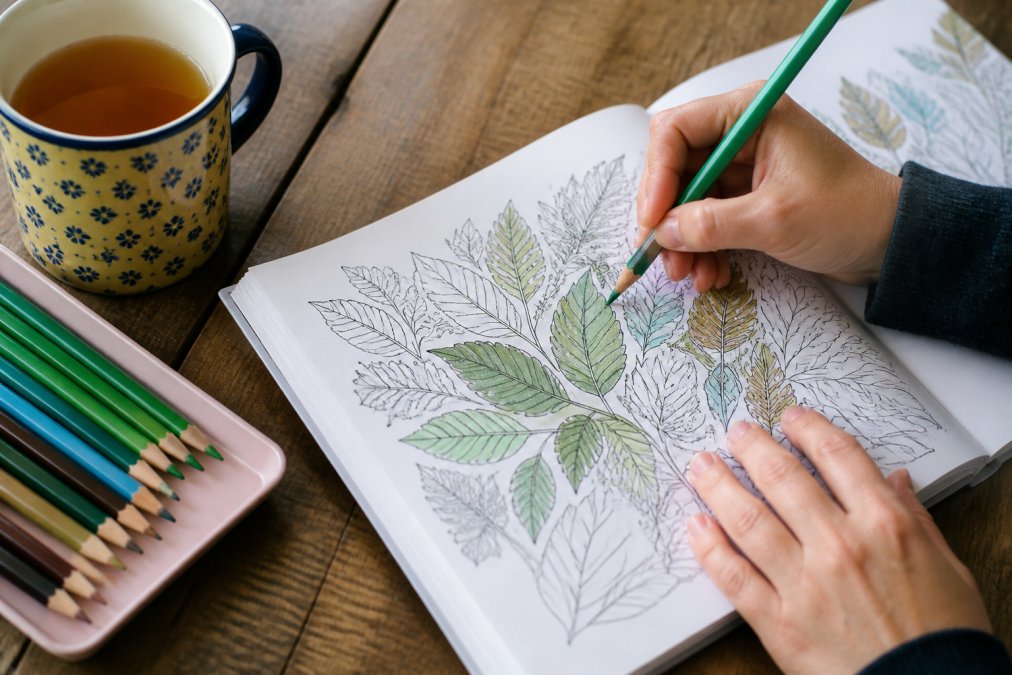
Here’s a starting plan that works:
- Pick one small, contained design for your first page.
- Test your markers or pencils on a spare sheet.
- Fill the largest areas first with your lightest color.
- Add mid-tones, then use your darkest shade only for shadows and edges.
- Leave white space where light would naturally fall.
- Stop when the page looks balanced, not when every inch is filled.
What most guides miss is pacing. Twenty minutes a day beats a three-hour marathon, because your hand stays steady and your color choices stay deliberate.
The Therapeutic Benefits of Adult Coloring: What the Research Says
The therapeutic benefits of adult coloring come from structured, repetitive focus that quiets racing thoughts and lowers arousal after a stressful day. Many colorists describe it as a form of active meditation, and the American Art Therapy Association’s overview of art therapy explains how creative repetition supports emotional regulation.
That’s why the format matters so much for focus-driven colorists. Repetitive detail work gives the brain a single, absorbing task. Simple designs don’t hold attention the same way.
For people managing ADHD, the key is genuine complexity with variety, not childish repetition.
Seniors often benefit from larger print and bolder line work. The goal is cognitive engagement without frustration.
The benefit isn’t in finishing the page. It’s in the twenty focused minutes you spend on it. Choose a book whose complexity holds your attention for that long, and the relaxation follows.
How to Choose the Right Book for Your Skill Level, Focus Needs, or Gift List
Match the book to the person, not the trend. A beginner needs medium complexity and forgiving paper; a gift buyer needs to know the recipient’s preferred medium and any vision or hand-mobility needs.
Use this quick decision framework:
- Total beginner: Medium complexity, heavy single-sided paper, mixed themes.
- ADHD or focus-seeking: High complexity with varied themes to prevent boredom.
- Arthritis or low vision: Large-print designs with bold, open line work.
- Marker user: 100 lb / 160 gsm paper or heavier, single-sided pages.
- Pencil user: Slightly textured paper that holds pigment.
- Gift buyer: A themed collection that matches a known interest.
If you’re unsure, buy a book with varied complexity across pages. It lets the recipient grow into harder designs instead of outgrowing the book in a week.
This is where a curated collection earns its keep. Beautiful Coloring Books offers over 320 unique inspirations spanning nature, fantasy, and abstract themes, with designs suited to every skill level and convenient delivery through Amazon KDP.
Don’t buy a book based on a single cover image. Covers often show the most dramatic page in the book. Look for interior samples before you commit.
Choosing the right book comes down to one thing: does the paper, binding, and complexity match how you actually color? Get that wrong and the hobby fades in a week. Get it right and it becomes the calmest part of your day.
Beautiful Coloring Books makes that choice easier with a curated selection of over 320 creative inspirations, designs for all skill levels, and themes spanning nature, fantasy, and abstract art, all available through convenient Amazon KDP delivery. Browse the collection and find the book that fits your hands, your focus, and your evening.
Frequently Asked Questions
What are the benefits of coloring intricate nature designs?
Coloring intricate nature designs gives your hands a focused task while your mind settles. The repetitive motion of filling small leaves, petals, and textures occupies attention without demanding decisions, which many people find calming after a demanding workday. The finished page also gives you a visible result, which supports a sense of accomplishment. Adults with ADHD often use this kind of structured, detailed work to stay engaged, while others simply enjoy the screen-free break.
What markers are best for intricate coloring books?
For fine detail, look for dual-tip markers with a brush end and a fine point, since the fine tip reaches small spaces without bleeding past the lines. Water-based markers are easier to control and less likely to soak through. Always test on a spare page first, and place a sheet of cardstock behind your work to protect the next design. If you prefer pencils, sharpened colored pencils give you the most control on tight floral and leaf patterns.
How do I choose the right paper quality for adult coloring books?
Check three things: paper weight, whether pages are single-sided, and how the book is bound. If you color mostly with pencils, a slightly lighter paper is fine and usually costs less.
Are intricate nature coloring books good for stress relief?
They are, largely because of how they direct attention. Working through detailed patterns pulls focus away from racing thoughts and toward a single, manageable task. The therapeutic benefits of adult coloring come from that shift, not from the artwork itself. Pair it with a comfortable chair, good lighting, and 20 to 30 minutes without notifications, and the effect is easier to notice. Many people treat it as a wind-down routine before bed.
